
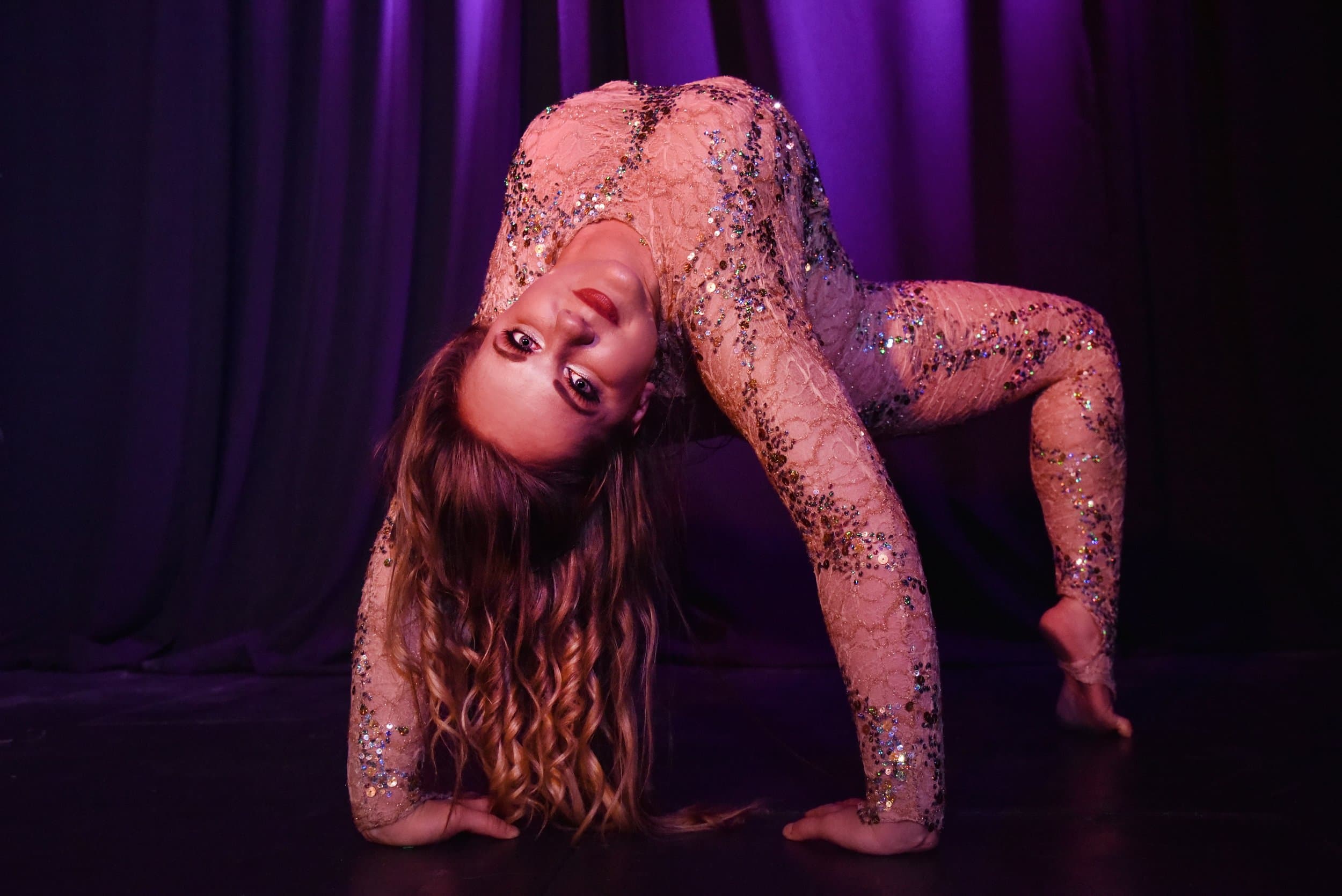
Melbourne · $60–80 per workshop
Contortion classes
taught properly.
Backbends, chest stands and active flexibility — trained safely, from foundations, by a professional contortionist who performs what she teaches.
Two workshops, one method.
Contortion Foundations
$60–80
The entry point. Spinal mobility, bridge mechanics, shoulder and hip opening, and the conditioning that makes deep bending safe. Built for adults starting from ordinary flexibility — most of the room is exactly that.
Contortion Flow
$60–80
For benders with shapes who want sequence — linking backbends, chest stands and transitions into movement that reads as performance. Musicality, lines and the control between the shapes.
Melbourne has world-class pole and aerial studios — and almost nowhere to learn contortion from someone who actually performs it. That gap is why these workshops exist. Groups are capped small; every body in the room gets coached, not counted.
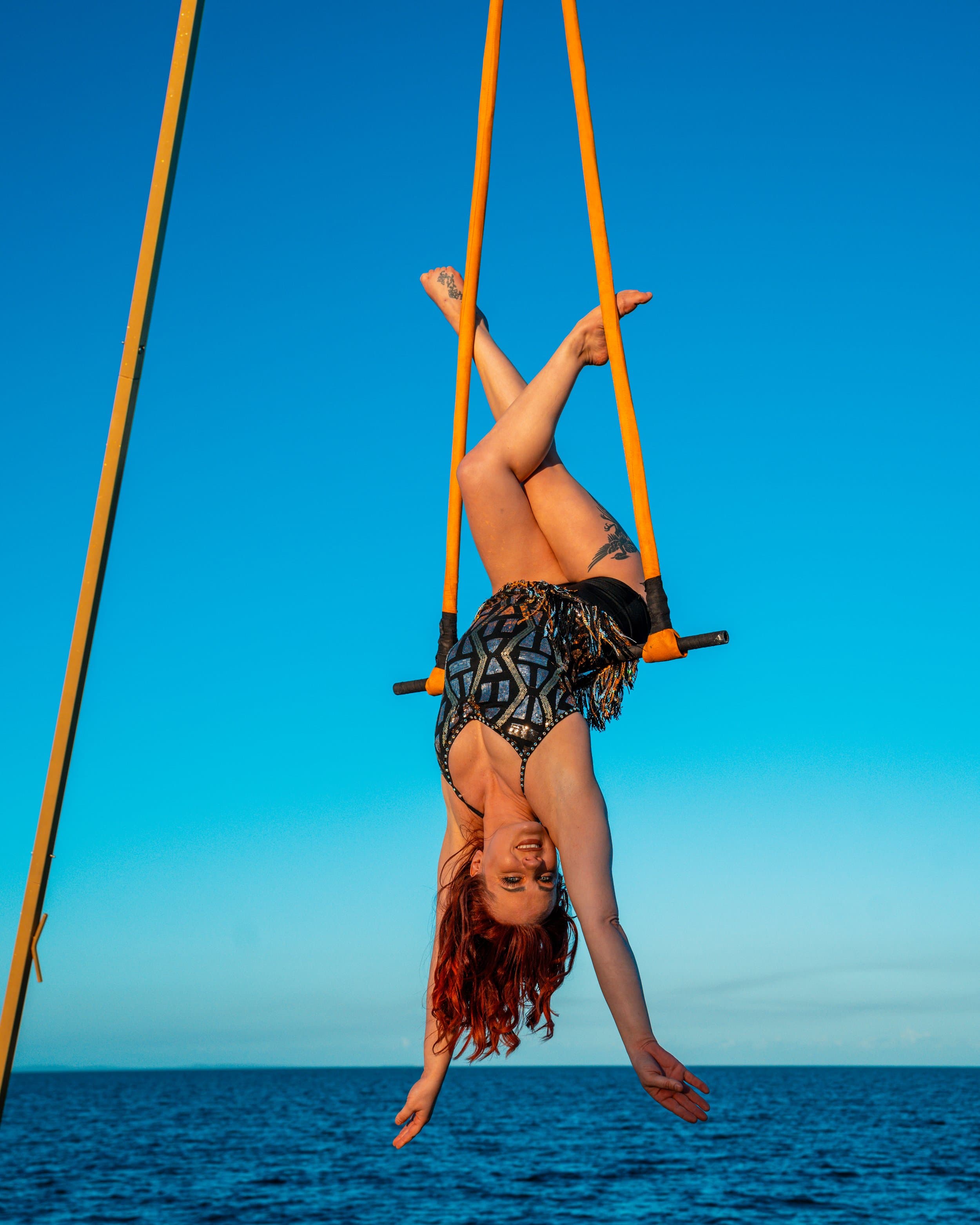
The work, in motion.
Illustrative footage — the real thing happens in class.
What you'll actually work on
The shapes you're building toward.
Foundations works these four in progression — each one scaled to the spine you have today, not the one Instagram says you should have.
Bridge & backbend
Where every contortion class starts. Bridge mechanics, even distribution through the spine, and the shoulder openness that stops your lower back doing all the work.
Chest stand
The shape people picture when they hear contortion. Built from the bridge over months, never rushed — and genuinely achievable for most adults who train consistently.
Front splits
Hamstring and hip flexor length, trained actively so you can use the range rather than just sit in it. The foundation for almost every line on an apparatus.
Middle splits
The slowest one to earn, and the one most people force. Trained through the hips rather than the knees, with conditioning that protects the joint.
What a session actually looks like.
Safe contortion has a structure, and it never changes: prepare the body, build the strength, then bend. Here is the shape of every class, so you know what you're walking into.
Warm-up (20 min)
Joint prep, spinal waves, shoulder and hip activation. Deep bending on a cold spine is how people get hurt — so it never happens here.
Conditioning
The strength that holds the bend: back extensions, core work, shoulder stability. This is the part Instagram skips and the reason our students keep progressing at 40+.
Technique & shapes
The day's progression — bridge mechanics, chest stand entries, splits — scaled per body. You work the version of the shape your spine is ready for.
Cool-down & homework
Gentle counter-movement, then your take-home drills. Two short sessions between classes beats one heroic Sunday — and you'll know exactly what to do.
Join the next Foundations block
Workshops are announced to the list first and capped small. Email or DM to hold a spot in the next round.
Contortion questions, answered honestly
I'm an adult with average flexibility. Is contortion realistic for me?
Yes. Contortion Foundations exists precisely for adults starting from normal flexibility. You will not chest-stand in week one — you'll build spinal mobility, shoulder openness and the strength that makes bending safe. Progress is real and measurable; party tricks come later.
What's the difference between Foundations and Flow?
Foundations builds the shapes: bridge work, backbend conditioning, splits progressions, safe warm-up habits. Flow is for benders who already have shapes and want to string them into sequence and performance. If unsure, start with Foundations — nobody has ever regretted it.
Is deep backbending safe?
Trained progressively with proper warm-up and strength work, yes — that's the entire method. Veronica has trained and taught this for 18 years without shortcuts. What's unsafe is chasing Instagram shapes cold. If you have a spine injury history, tell us before class and we'll adapt or refer you.
How often do workshops run, and where?
In blocks across Melbourne, with regular sessions in Brunswick. Dates go to Instagram and the email list first and workshops are capped small, so they do fill.
How much is it?
$60–80 per workshop depending on length. Private contortion coaching is $120/hour in person or $100 over Zoom, with four-packs at $380.